Showing posts with label editorial. Show all posts

Wednesday, September 24, 2014

Mordekai's Original Games, Pt. 2

By Mordekai


In the last installment, I looked at some of the early computers I worked with.  It occurs to me that I failed to mention the Radio Shack Science Fair Digital Computer Kit.  While this was mostly a toy, using it as a kid taught me about logic circuits, program algorithms and program flow.  However, I digress.  In this installment, I’ll look back at some more computers from the early days.


Tandy TRS-80 Model 100

I picked up a TRS-80 Model 100 from Radio Shack when I was in-between desktop models.  The Model 100 was quite the machine for its time, having a built in address book and word processing software.  It also had Model 100 BASIC in ROM and 16kb of RAM.  Biggest thrill of all for this little laptop was a built in 300 baud modem.  I used the Model 100 for my first on-line experience by calling up Compuserve and using my free subscription for 30 days.  As the payment for Compuserve was almost as much as my payment for the Model 100, I opted not to continue to use Compuserve.  That’s when I discovered the Bulletin Board Systems.  Programming the Model 100 was more involved and difficult than the old Model I.  I created some short-run text adventures.  It turned out to be mostly a novelty item as I started doing all my programming on a TI-99/4A.

Texas Instruments TI-99/4A


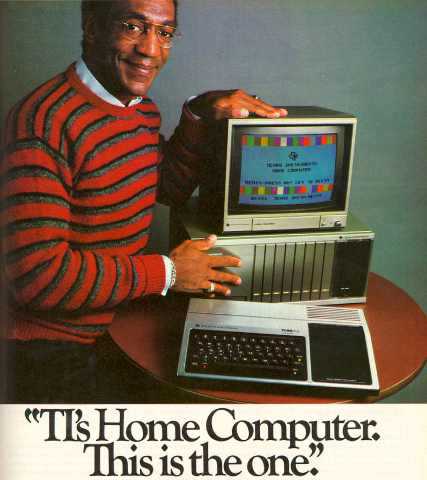
Texas Instruments busted into the home PC market in 1979 with the TI-99/4, which was the first 16-bit home PC.  It sold for a whopping $1,150 and featured a wide range of peripherals and TI’s “solid state software,” which was ROM cartridges, like an Atari.  The TI-99/4 was a giant flop and was replaced in the early 80’s by the TI-99/4A, which sold for half the price and had twice the features.  TI made several mistakes with the 99/4 series, the most serious of which was to disregard hobbyists and hackers as a source of ideas and information; the second was not allowing third-party resources such as game cartridges and peripherals.  TI suffered hundreds of millions in losses, mainly because of those mistakes. 

I purchased my TI-99/4A brand new, in late 1983, from a Target store in Rapid City, SD, for $50.  At the end of 1983, TI was unable to compete with Commodore, Apple and IBM, so they dumped their systems, dropped all support functions and got out of the microcomputer business until the early ‘90s. Even though it tended to look like a toy, the 99/4A was a fairly powerful machine for its time.  I programmed my first graphical game on the 99/4A -- a rudimentary joystick-controlled Space Invaders wannabe.  The 99/4A also featured the ability to produce musical tones.  The programming book had a list of notes and frequencies.  I had a guitar-playing friend, Scott Aldrich, ask me if I could program the notes for Freebird into the computer.  I can’t play a single lick of music -- but I can program.  Scott told me what notes to program and I hot-keyed them from 1 to 9.  Using the 99/4A as organ, we laid the background tracks for the Skynyrd classic.  Scott played the rhythm guitar and would nod at me each time I needed to change notes.  We recorded the background track on a stereo cassette tape recorder.  We then played the background music on my home stereo as Scott played the lead guitar and I kept rhythm with a Michelob bottle filled with popcorn kernels.  We recorded the whole song, minus vocals.  It was my coolest use of the TI-99/4A.

Commodore VIC-20 and Commodore-64


I never owned either of these machines.  My main activity regarding the Commodore computers was to make fun of them because I owned an Apple //e.  However, I have a short story.  When I was in Rapid City, I lived in military housing.  My neighbor to the north had a VIC-20 and my neighbor to the south had a Commodore 64.  We all had chess programs for our respective computers.  I had a program for the Apple called Sargon III.  It was a great chess program for its time.  One day, after we’d lost a chess match to his computer, my neighbor with the VIC-20 (his name was John Hancock -- I am not making that up -- true story) said, “I bet my VIC can beat your Apple.”  I said, “No way.” We brought the VIC to my house and played the computers against each other, giving each the same amount of “think” time.  Sargon slaughtered the VIC-20.  I don’t recall the name of the VIC chess program, but it was not even a challenge for the Apple with Sargon III installed.  So then, the neighbor to the south challenged my Apple with his Commodore 64.  After my victory over the VIC, I wasn’t too concerned about the 64 as I knew they were pretty much the same machine.  I wasn’t wrong.  Sargon III humiliated the Commodore and they never challenged me again.


Apple //e


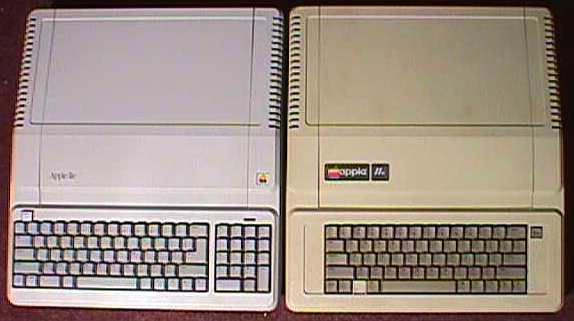
I bought my Apple //e, with a single disk drive and green-screen monitor, in 1984.  I used it for everything from writing as a military journalist to evaluation of demographic data for magazine readership using the Appleworks Spreadsheet.  Mostly, I played games.  By the time I gave up the Apple in 1994, I had well over 1000 disks, almost all games, as well as 5 floppy drives, two external modems, and a color printer.  I produced three issues of The Reformer Magazine using the //e.  I ran a Bulletin Board System using floppy drives and a RAM disk card.  I even wrote my first paid program for the Apple //e.

In 1994 a friend of mine, Tim Johnson, had a master’s degree project in electrical engineering to calculate the efficiency of a solar cell based on several adjustable parameters.  It was a challenge.  He said, “I thought I’d just show you the math and you could make a program.”  He showed me the math involved and I said, “You’re going to have to explain that to me.”  Once I understood what the math meant, I actually had to write subroutines to calculate hyperbolic trig functions because they weren’t built into Applesoft BASIC.  The end product would ask for parameter inputs, then perform the calculations to determine the efficiency of the cell as a percentage of solar energy converted to electricity.  In addition, the program would screen plot and print a wave graph showing the ramp and peak of the cell.  It took it 36 minutes to run on my Apple //e.  Tim said he couldn’t wait that long for the number of results he had to produce and wanted to know if I could put it on his IBM 386-50.  So, I re-programmed it on the 386 using Q-BASIC.  It would run in under 3 minutes.  At that point, I realized I’d have to upgrade.  But I was sad.


So I upgraded.  Next time, we’ll talk about my first IBM compatible and an original Intel 286 processor computer I built from scraps on a piece of plywood.


John Smith (AKA Mordekai) on Google Plus

Saturday, August 16, 2014

The Movie Tie-in Game Done Right

Screenshot courtesy Brandon Smith (Mordie the Felifox)

In the world of video games, there are few products more universally maligned than the movie tie-in title. Games tied to Hollywood blockbusters are typified as being shallow and rushed, with little value as stand-alone products. Sadly, in many cases this hate is well warranted: often movie tie-ins, or games designed as product placement in general, are build on slimmer budgets and much more stringent guidelines than standalone releases face. Games of these types are not typically seen as art or entertainment with their own merit, but rather as advertisement platforms for the product they are tied to, and therefore are often deemed expendable.

Keep that word expendable in mind: it will be important later on.

There are exceptions, of course. Goldeneye, the legendary FPS for the N64, is often cited as the best example available for a movie tie-in handled well. Unfortunately, Goldeneye is successful specifically because it fails to follow the typical movie tie-in path; being released several years after the eponymous movie meant the game had plenty of development time for concept, presentation, and gameplay. On top of that, the game's lack of drive as a marketing tool opened the developers up to being able to incorporate elements of the James Bond universe as they saw fit rather than being constrained by the film itself, allowing them much more freedom to express what they wanted in the game rather than what any marketing department wished for. Likewise, many of the other games that are usually used as examples of positive movie tie-ins -- Alien Versus Predator, many of the Lego games, or even titles like Telltale's Back to the Future adventure games -- serve more as the exceptions that prove the rule than as truly great tie-ins: they are developed outside the typical effective marketing times for their respective franchises, and with much more developer freedom than the typical tie-in receives because of that.

With so much going against them, can a movie tie-in really be done right?

Yes, yes it can, and for proof of that fact you need look no further than The Expendabros on Steam.

At first glance The Expendabros looks as though it has very little going for it. For one thing, the game is completely free: that's right, free. For another, rather than being a scene for scene retelling of the movie, The Expendabros, which is intended as an advertisement for The Expendables 3, chooses to embrace its game nature and do its own thing, referencing characters and concepts from the film rather than trying to represent the movie's contents in a more dedicated manner. Lastly, the game is done quite clearly on the cheap: rather than being a brand-new game The Expendabros is instead presented as more of a modified version of Free Lives and Devolver Digital's creative shooter Broforce, with a handful of sprites and cutscenes being the only things that distinguish the product as its own thing.

All of these elements sound like negatives at first, but in truth, it is in these elements that the game finds its greatest strengths as a marketing tool, and as a game.

Let's start by discussing the price tag. Perhaps one of the greatest atrocities many licensed games commit is not their rushed production times or general lack of creativity in design, but rather in how much they expect players to pay. If a product is, in essence, intended for promotion of another product the company expects to make the real money off of, then it stands to reason to offer the promotional product at a discounted rate. Despite this, licensed games are often on an even keel price-wise with AAA console releases, making the flaws they often exhibit -- which many would overlook more easily in a more modestly-priced product -- that much more of an issue.

This pricing issue is not a problem for Expendabros. By being free, the game offers even the most lackadaisical viewer a hard to ignore opportunity to experience a small part of the Expendables franchise. This makes it an ideal marketing tool for the movies, and even for Free Lives' game Broforce, which Expendabros is based on. By offering the tie-in for free, players have little reason to be disappointed or turned off by the product's content based on financial input, and are therefore more likely to view its fun elements in a positive way, reflecting on the franchise as a whole.

Now we'll move on to the game's deviation from the movie's core. Often times licensed games rely on following a movie's storyline as closely as possible in order to appeal to the movie's target audience as much as they can. This is meant to serve to reinforce both the impetus to watch the movie if you've played the game and the drive to convince moviegoers to delve into the game if they like the movie, since they are typically two different ways to experience the same overall story.

Unfortunately, doing this doesn't really work for games, primarily due to the difference in narrative devices needed to properly carry a game story as opposed to a film. Games based on film or TV franchises too often stick players on a set path with little room to deviate from it; rather than embracing the idea that the story is being told as a game, instead it wants you to watch a CGI rendered version of the movie with occasional inputs into actions that have little impact on the actual events at play.

Expendabros manages to avoid these pitfalls by placing its emphasis less on trying to duplicate the film and more on trying to emulate the attitudes of the source material. By emphasizing the idea of being a game about the Expendables rather than a direct tie-in to the movie, the game frees itself to have fun with its contents in a way most licensed games don't or aren't allowed to.

Part of the reason this works is due to the game's existence as more of a mod or total conversion than a fully original title on its own.

I know, I know; I hear people complaining now that if the game doesn't do its own thing then it lacks artistic merit and value. Here is where the core concepts behind a licensed game will differ from the goals of the typical game, however, and that is that the goal with a licensed game is not for the game to stand out on its own at all, but to serve as effective promotional material for the franchise it is based on. What this means is that, when it comes to licensed games, by focusing on using an appropriate system that is already in place, developers can more effectively advertise the product they are supporting.

Notice I said appropriate system.

What makes Expendabros stand out from many other licensed titles is that the genre the game embraces fits its license perfectly. The Expendables franchise is intended to be the distillation of every cheesy action movie ever, so by choosing Broforce's explosion-filled bullet-hell gameplay to represent its game-world presence Lion's Gate chose amazingly well. By choosing a genre that represents the game equivalent of what The Expendables represent in film, the game has a much higher chance of not only appealing to gamers on a purely game-based level, but also targeting the portion of the gaming market that is most likely to be interested in the movie itself. This is a key element many licensed games miss, and why we have a tendency to see generic adventure and platform titles released for most franchises: these are often the simplest concepts to work into the narrative of the film's story, but will often times not truly fit with the type of game the target audience for the film would enjoy.

So, in The Expendabros we have a game that A) is marketed at a price point that will appeal to gamers and non-gamers without setting any kind of expectations regarding content or quality, making it an effective marketing tool for the film franchise, B) lets itself deviate from the film's core story, allowing both the game and the film to operate as separate entities with their own elements while still sharing many elements, and C) embraces a genre that works to represent the same core ideals and philosophies as the film does, helping the game to appeal to the same market as the film targets.

All together, these elements combine to make The Expendabros an ideal example of a movie tie-in game done right, even before we get to the single most important element of all: the game is FUN. The game finds merit even without its film tie-in elements through simply being a blast to play and offering players a good amount of options to build on their experience when doing so, and through this further improves its ability to advertise the film franchise it is based on. A good game, no matter how little connection it might actually have with its franchsie source material, will always serve as a better draw for audiences than a game that stays true to its material but fails to be an enjoyable experience. Look at products like the Lego games for a great example of this: often, the Lego games will deviate wildly on story elements form their source material, and the worlds are always far different from those represented in film, yet the games still serve to draw players due to their accessibility and enjoyability. In turn, players then associate that enjoyable experience with the franchise as a whole.

In the long run, isn't that what any promotional material aims to do, is emphasize the enjoyment one can draw from the product being advertised?

What movie tie-in games have you played in the past? What have you thought they did right, or wrong, and do you think they served their purpose as promotional materials for the franchise they were tied to? Let us know.

Tuesday, August 5, 2014

Editorial: The Games That Define You

Welcome, yet again, to a long-delayed yet much needed addition to our content here at Game Academy HRO.

If you're reading this, then congratulations! You are, most likely, a gamer of some kind. I've ranted on "hardcore" versus "casual" on here already, so we'll avoid that again. Instead, today we're going to talk about a whole different aspect of games, and those who play them, and that is what games we enjoy, and why.

Games are more than children's toys. Sure, to many of us this seems like a given: after all, who would ever mistake the contents of a game like God of War or Europa Universalis as the playthings of youth? And yet, this is a misconception that many people have. This misconception is not limited to the video game industry, mind you: board games and, to a lesser extent, card games (of both the trading and non-trading varieties) face the same stigma. Even role playing games such as Dungeons and Dragons or the World of Darkness titles see feedback from groups claiming that they are aiming to corrupt youth when the target audiences of many of these products are individuals in their twenties and over.

Luckily, this is a stigma that is gradually wearing thinner in our culture as those who have grown up with a wide variety of games as an integral part of their life become our cultural leaders. Film stars, musicians, even politicians are known to play games nowadays, and much like the animated film medium has managed to (mostly) overcome its image as a childhood pastime to be avoided by those of more "mature" sensibilities, gaming, in all its various forms, is reaching that same point.

One thing that gaming does lack in comparison to many other artistic or expressive mediums, however, is individual legitimacy, by which I mean, people's acknowledgement of what games, or even a specific game, have meant to them during their life, and how that game has changed them.

There are stories of this out there. Only a few months back a well-known gaming site (who will remain nameless) released an article from one of their writers about how the Tomb Raider series helped to inspire her to be a strong, action-oriented woman. Likewise, within the industry itself there are plenty of people willing to express how one game or another influenced their decision to jump into the industry themselves. Outside of those who are already considered "gamers" by definition, though, and are already a part of the community as it were, gaming has yet to find a true voice among the populace.

Ask any film star or politician and they can tell you their favorite film, favorite song, and favorite book. More than that, they can tell you why those properties are their favorites, whether it comes down to emotional content, aesthetics, or simply quality of construction and storytelling. Many of those same stars and businessmen/politicians would simply glare at you or shake their heads, though, if asked about a favorite board or video game, and this needs to change.

As I stated at the beginning of this article, if you are here, and you are reading this, then you are in all likelihood already branded a "gamer" of some type. Those of us already in the community can attest to the fact that games can and do have a profound influence on those who play them.

So, why don't we admit to this influence in our day to day lives more?

Imagine it is the 1930's, and you are talking to a friend about artistic merit. You mention Mary Shelley, she mentions Lovecraft, and you summarily chew her out for choosing such trash and trying to call it art. This is our situation now, and though time will, one day, give our medium the love and respect it deserves, for the moment we are pop, we are pulp, and we are laid low by the lack of respect we receive from other sources.

How can we change this?

Simply through expressing our love for our medium, and letting others know that games, just like any other form of entertainment or art, can influence you, and help you to define who you are.

There are dozens upon dozens of games that I have loved during my life, but like with books, movies, or songs, there are only a happy hearty few that I would say have helped to define who I am. Dungeons and Dragons sits right there at the top of that list; I was a latecomer to the series, twelve when I first picked up a used Dungeons and Dragons second edition starter set at a yard sale and already well versed in video and board games, yet the impact of that box set on my development was profound. From that box of pamphlets and crude pictures, and the books I have read since, I have learned more about storytelling, world building, and character construction than I ever picked up from a class in school. By reading about and playing Dungeons and Dragons I learned to apply more than pure imagination to what I wrote and built: I learned about logic, and balance, and action-driven narrative, and many other elements that apply not only to my artistic interests but also to my interactions with other people, albeit in a more cerebral and sardonic way.

With video games, my biggest influence has likely been Doom. As part of the first generation to really grow up with 3D games as a major part of their youth, Doom helped to define for me what tech was capable of, and as I grew older and learned more of the history behind ID and the game' development, it helped to show me what a small, dedicated team of enthusiastic individuals could accomplish with a little perseverance. It was something so much more than an engine or a new graphical aesthetic: Doom was, in many ways, the dawning of a new era in games, for better or worse, and is to this day one of the games I find myself most often delving back into to experience again. The impact Doom had on me as a child was profound, but the influence it has continued to hold over me as I have grown older has been no less important.

These are only two of the many, many games that have helped not only to entertain me, but to teach me, and to help me grow as a person. As much as books, or art, or movies or music or anything else, games have helped to give me artistic direction, strength, and determination in life.

What more can you look for in a work of art, than to influence, in some small way, how you define yourself, either in relation to yourself or to others?

Thursday, May 22, 2014

Post Types On Game Academy

In the future posts on Game Academy HRO will be loosely divided into categories, defined by not only the labels used for the posts but also by the titles themselves. Currently the intended post types are as follows:

Gaming lessons

No, these are not going to be pretentious "this is what it means to be a gamer" posts or how-to-plays or guides on how to think. Gaming lessons are going to be site content engineered toward understanding and appreciating the history and significance of gaming in its myriad forms. These lessons will follow a class-styled naming convention, consisting of the lesson value (Gaming 101, Gaming 302, etc,) followed by the subject matter of that lesson. Start looking forward to "Gaming 101: What Is A Game?" some time in the near future.

Tabletop Concepts

Tabletop Concepts are going to be articles and even opinion pieces focusing on tabletop strategy and role playing games. In these the site will focus on discussions about game mechanics, systems, and the roles tabletop gaming has played in culture from a less historically-oriented perspective.

Reviews

While the long-term plan is to have reviews play as small a role in the site's content as possible given their abundance from other sources, reviews will nevertheless appear on occasion. Reviews will always be the opinion of the writer and not of the site as a whole, and will be labeled by the system the review is for, such as in the case of our Arkham Origins review.

Opinion Pieces

Opinion pieces and editorials, at this time, will not have any special naming conventions applied, so if an article or piece appears that does not have a colon in the name, it's automatically an opinion piece. While the long term plan is to phase these into only sporadic content, much like the reviews, the short-term is likely to see many of these pieces to help build content strength for the site.

More content types will possibly be added to our repertoire in the future, but for now, these are the types of content you should expect to start seeing in the near future.

Monday, May 19, 2014

Can A Game About Crime Be A Lesson In Gender Ethics?


I am a huge fan of the Saints Row series.

When I discovered this it came as a huge surprise. I can't stand the Grand Theft Auto series, or most any other game that sends you into a city with the intent being to wreak havoc and generally menace the civilian population all while murdering cops and committing felonies, yet I find myself oddly in awe of the Saints Row games.

There are a few reasons I feel more positive about them than others, but most all of those reasons can be summed up in two broader ones: firstly, that the games aren't afraid to embrace the fact that they're games, and second, the almost unerringly even hand with which the game treats equality of gender.

How can a game where you rescue hookers from boats and watch women parade around town in lingerie show gender equality? It's very simple: it treats men and women almost universally equal. Sure, the women in lingerie are more common, but a close look will also reveal plenty of men walking around in speedos and gimp masks, and of the major characters among both the villains and the antiheroes the women make up some of the strongest in terms of personality and impact. Like most women in video games they have their over-sexualized elements, but in a game where you spend a rather lengthy mission running around with a nude giant and another with one of your major male allies in pony gear pulling a cart, women in tight turtlenecks or who are blatant about their sexuality are almost tame in comparison. They are business owners, or public figures of power, or even staunch allies in combat, but one thing they most certainly never are is weak.

What's just as impressive as this treatment with the non-player characters is the game's treatment of your avatar. The game takes an AFGNCAAP approach to NPC dialogue throughout, with multiple voice tracks for male, female, and even zombie characters all changing subtleties of the dialogue and blending wonderfully with every other spoken line in the game. Your character can be as fat, thin, ugly, pretty, or even well endowed (male OR female) as you care to make them, and regardless of your choices your character's grand-scheme sexuality and personality are kept ambiguous enough to fit with any style of role-play a player could want within the restrictions of a game about criminal fantasy. The game actually rewards you for changing your character's sex in-game and devoting play time to both sexes throughout your in-game career.

Most of all, permeating every fiber of every element of this, the game has a sense of humor about what it does. When it's being sexist -- in either direction -- the game is not afraid to fully embrace that and play its sexism for all it's worth, the same as it does for casual violence, crime, and even the world itself, a setting where mass murder and misdemeanors are marketing ploys and publicity stunts. It's a game that WANTS you to see how over the top everything it does is, and in that way it negates the very problems it seems to promote.

It's satire in its purest form, and is one of the best treatments of gender as a whole I can remember experiencing in any game ever.


The issues concerning the representation of women in games has long been an issue within the industry. Many are the arguments one will hear either justifying it or condemning it, and there are well-reasoned arguments on both sides of the divide. Because of this, I am resolutely not going to get into the greater issues concerning whether games are targeted toward men or women as a whole. Instead, what I am going to touch on is a smaller and in my personal opinion more important issue entirely and that is the ethics of the treatment of gender in games on an individual level.

I should probably start with defining what I mean by "the ethics of the treatment of gender," or to shorten it let's just call it "gender ethics" from here on out. What I mean by this is how a game handles gender regardless of any perceived target audience by treating players, whether they are perceived to be men or women, boys or girls, with an equal amount of respect concerning mental capacity, gameplay skill, or even tastes in content.

Using this as our guide for what "gender ethics" means, it is easy to see how many games fail to take this into account to any great degree, worst of all games that are supposedly targeted toward improving equality in the gaming market.

The Rules of Gender Ethics

Rule 1: Gameplay Content Does Not Dictate Player Gender

This is one of my first, and most major, peeves with gender ethics in games, and that is the mistaken notion that the way a game is intended to be played or the way the content in it is presented somehow makes certain games more, shall we say, gender-savvy than others. Many are the times I've seen arguments promoting games like The Sims, or Peggle, or even the Imagine series on DS as examples of female-oriented games, and to me this is a terrible tact to take. By insisting that certain games are more appropriate or better exemplify the types of content most often sought by one gender or the other people on both sides of the gender equality arguments are missing the mark.

Is it a fact that male and female brains function differently in some ways? Yes; but that is no justification for applying some false gender emphasis on what the content or gameplay style of a game should be.

Ironically enough I consider games that are supposedly oriented toward girls or female players to often be the worst offenders in this way. I used the Imagine series as an example above for good reason: they are intriguing ideas for games that lose a lot of their value through misguided gender emphasis in their marketing and design. By emphasizing their target activities as exclusively feminine -- subjects such as fashion design, veterinary work and even teaching being in the series' repertoire -- they are dealing a double whammy to gender equality in games. Not only does their insistence on the femininity of these activities actively discourage male gamers interested in the subject matter (and, let's face it, given the popularity of clothing mods in PC games there are more than a few male gamers who would have a blast with a fashion game,) but it also works as a subliminal hint to girls that these are the kinds of games they should look at instead of the next shooter or the next adventure game. Their very pride in the supposed gender they appeal to is their biggest problem.

The games that most often exemplify the most positive gender ethics more often fall into the adventure, puzzle, or simulator genres, because in many of these games gender serves primarily as an aesthetic choice and only in a secondary or even tertiary capacity to influence story or interaction options. Games like The Elder Scrolls series or Bioware's epic RPGs where a character's personality and, often, love interests, can be steered in any of a variety of ways without making what they are more important than who they are. Meanwhile many puzzle games benefit from the concept of removing gender as a factor entirely. While Peggle and other Popcap or "casual" games often appear on the lists advocates use to provide proof of female gamers, their greatest achievement is from removing gender from the gameplay equation at all.

The key here is that equating a game's genre or goal with the gender most appropriate for it is detrimental to the industry as a whole. Girls play shooters, guys play The Sims, and I know plenty of young men who would enjoy games about training horses or managing a small business oriented toward personal hygiene if the covers weren't saturated in pink and sparkles in a mistaken goal to target girls. Why gender concepts and content that don't need it?

Rule 2: Men And Women Are Not Two Extremes

I absolutely adore character creation in games. I love having the flexibility to choose how I appear in the game world and to see what options the game gives me to customize my avatar to fit who I want them to be. And yet, I often find myself underwhelmed or even annoyed by the options presented to me in games because of their reliance on definitive sex templates to define who a character is. If you build a woman she is going to be curvy and feminine: if you build a man he is going to be broad and strong. You have some flexibility within this, and more and more games are allowing the option to alter sexual attributes within certain limitations, but those limitations are often set on the outsides of biological norms, and are far from all-inclusive.

By creating a hard separation between men and women in the way characters are designed, games do little to promote an open understanding of sex, sexuality, and gender within their game worlds. Often times this will even extend to garments and objects one finds within a game. Many have been the times I've picked up a pair of pants in Oblivion only to be dismayed to find them transform into a skirt on my character because I had chosen to tick the F rather than the M during character creation. Likewise when playing Fable I've found outfits or even hair styles I would want to use for my character only to be faced with the problem of earning points in a "crossdressing" score that would often negatively impact my character's interactions with others. By applying these gender stereotypes games fail to embrace inclusive ideals and instead perpetuate needless double standards in regards to both males and females.

Once, just once, I would like to see a game where I can create a flat-chested thick-waisted female avatar, or a pretty male avatar with slight curves, just to be able to experiment with the variety that truly exists in nature concerning gender and presentation. The same goes toward personality traits as well. Let the player create a male character who is soft-spoken or gentle without tying aspects of abnormality or strangeness into their person, or let them create a broody, dark and terrible female figure who nobody would every accuse of using her sexuality to get her way. Not only does embracing such variance vastly increase the options available for characters in games both for the players and developers, but it makes the world feel more real than spending every day among the supposed ideals of society, and therefore more inclusive.

Rule 3: Your Main Character Does Not Define Your Audience

While character customization has become much more common in games than in the past, especially in regards to one's sex, many games still rely on a predefined and definitive character or characters for gameplay.

There is absolutely nothing wrong with this. Games, like movies or books, are often a storytelling medium to at least some capacity, and as such will often necessitate a specific character archetype to carry the events of the story toward the predefined conclusion. Where this falls down is in the way that many game developers will use their main character to define a target audience for their game.

The examples of this kind of targeting are numerous, as are the examples that subvert the trend. Many early games especially manage to avoid this issue by presenting their characters in such a way that the character itself is less important than the actions they perform. With modern games, though. . . .

As a youth I always enjoyed first person shooters. I grew up playing games like Doom and Dark Forces on my grandmother's computer before later graduating to Half Life, Quake 3, and even a little Halo. More recently, however, I have found these games harder and harder to get into or appreciate because of the portrayals of not only the main characters, but the reactions of the NPCs around them. Many third person games have this same problem, and it's an issue we as an industry inherit from the film industry: the main character is treated AS the audience, with little regard for differing opinions or feelings. The issue arises due to the difference in mediums. While a movie is a predefined series of events from an outside perspective, games are most often treated as an active continuity, with the player intended to either empathize with or at the very least maintain interest in the welfare and actions of main character.

Put more simply, it is easier to watch a movie with a character you don't identify with than it is to play a game with the same issue.

Unlike the other "rules" -- and I use that term lightly -- this one falls into much more of a gray area, partially because it extends to more than gender and sexuality: it covers a character's entire attitude. As such, there are plenty of cases where a character's attitudes defining the game's target audience make perfect sense!

Yes, that's right, there are times -- many of them -- when this rule can be ignored. If so, why bring it up?

Because there are also times -- again, many of them -- when ignoring this rule is detrimental to a game, and these situations almost always involve blatant sexism in the attitudes of either the game's characters, or the developers.

I mentioned at the very beginning of this article that I can't stand the Grand Theft Auto games, and this rule here is one of the major reasons why. Beyond being a criminal, the character you are expected to play in these games always seem to embody the worst elements of masculine attitudes. Several of the characters in the series are womanizers, and worse than that their interactions with women are almost always in a manner that objectifies them or sexualizes them far more than is needed for the narrative to be effective.

The GTA games are incredibly popular, but most girl gamers I know who like the series are hesitant to admit it, in no small part because of the sexism shown throughout the games.

Even games with female protagonists are far from immune from this attitude, though often times they take on the visage of femme fatales who use their sexuality to overcome obstacles in a way that is neither empowering nor positive for female gamers, ending up as nothing more than sexual fantasies for the male audiences they're targeted at.

Again, games like these will always exist so long as games exist as entertainment, but developers could very much benefit from taking into account whether targeting the audiences who seek this type of thing is of benefit to their game, and if not, should seek ways to correct it.

Tomb Raider is a great example of a series that has reinvented itself at least twice in this regard. While early games placed a great deal of emphasis on Laura Croft's sexuality, many of the newer titles have moved away from this toward a character-driven focus. While overall the games have always served as some of the more female-positive games around, these changes over the years to refine the main character's image have helped to prove just how much the company cares about its protagonist and the impact she has on those who play her games. As such, Laura Croft has more than managed to remain relevant: she has managed to excel as an example of what gender-positive marketing can do for a series. It still has its problems, but as the company devotes time to correcting those they improve the series greatly.

Games that target a mutually gender-positive or sex-positive outlook will almost universally have greater appeal than those that choose to express more limited, negative viewpoints.

So What Did Saints Row Get Right?

Saints Row serves as a unique example of positive gender ethics by insulting and satirizing both sides of the gender divide equally. By taking the same approach to sex and gender that it takes to violence, crime, and everything else, the game manages to rise on a pile of be-thonged prostitutes and male sex slaves to take its place near the top of my personal list of impressively gender-positive games. By providing a strong cast of characters of different genders, nationalities, and attitudes the game comes out ahead of many much more consciously inclusive games in terms of open mindedness, embracing subcultures in a way most games can only dream of.

It's a pity more games don't live up to that dream.